How to drink spirits and understand them.
In a Glass
A tasting is not just drinking, it is understanding the liquid in front of you. It has a lot to do with your senses and also about your knowledge about spirits.
There is also a difference between disliking something and a flaw in the liquid.
The Senses
The process is always the same.
First, it’s always the visual analysis, where, among other things, we can discern details about the maturation time and the type of cask used by looking at the color.
Next in line for the olfactory analysis is the nose, as we hold it over the glass, and later, once more, retronasally, to identify the smell.
Finally the first sip for the gustatory analysis, for the five different tastes and also for the trigeminal nerve which let us feel the heat of alcohol, the cooling of menthol, or the tingle of sparkling drinks
If you want to know more about the senses, read The Senses Behind Tasting
Preparations
As mentioned, tasting is not just drinking, that is why we need to make some preparations.
Choose three to five different spirits from the same category, more than five is usually too much, because the brain starts to tire.
Take place in a bright room with no strong smell in the air.
I think it doesn’t need to be said that things like smoking before or strong perfumes make the tasting pointless.
Take your samples from a clear defined category, cause it makes no sense to compare a gin with a peated whisky, at a bit under room temperture and let them adjust to the temperature, ideally in a nosing glass.
Have something ready for writing and taking notes.
The tasting can begin, start always with light to intens, dry to sweet, young to old.
Visual Analysis
As mentioned, tasting is not just drinking, that is why we need to make some preparations.
Choose three to five different spirits from the same category, more than five is usually too much, because the brain starts to tire.
Take place in a bright room with no strong smell in the air.
I think it doesn’t need to be said that things like smoking before or strong perfumes make the tasting pointless.
Take your samples from a clear defined category, cause it makes no sense to compare a gin with a peated whisky, at a bit under room temperture and let them adjust to the temperature, ideally in a nosing glass.
Have something ready for writing and taking notes.
The tasting can begin, start always with light to intens, dry to sweet, young to old.
Use neutral light over a white surface and start with the visual Analysis.
Through this inspection, hypotheses and conclusions can be drawn about storage and production, such as maturation time, barrel type, oxidation and finishes.
Clarity: clear – hazy – dull
Color intensity: waterclear – pale – medium – deep
Hue: Colorless – Straw – Gold – Amber – Mahogany – Brown – Reddish – Tawny – Greenish –
Black Tone
Other notes: louche effect, particulates, chill haze
Olfactory Analysis
A lot of people swirl the glass for a tasting, for wine that makes sense to increase the surface area that smells of wine. With spirits, that can backfire. Spirits have a much higher ethanol content which is also more volatile and can numb your nose. Keep the glass at an angle and move your nose over the glass not into the glass. Alternate your nostrils, you don’t always smell the same on every side.
Repeat it after one to two minutes for a second sniff to detect deeper notes.
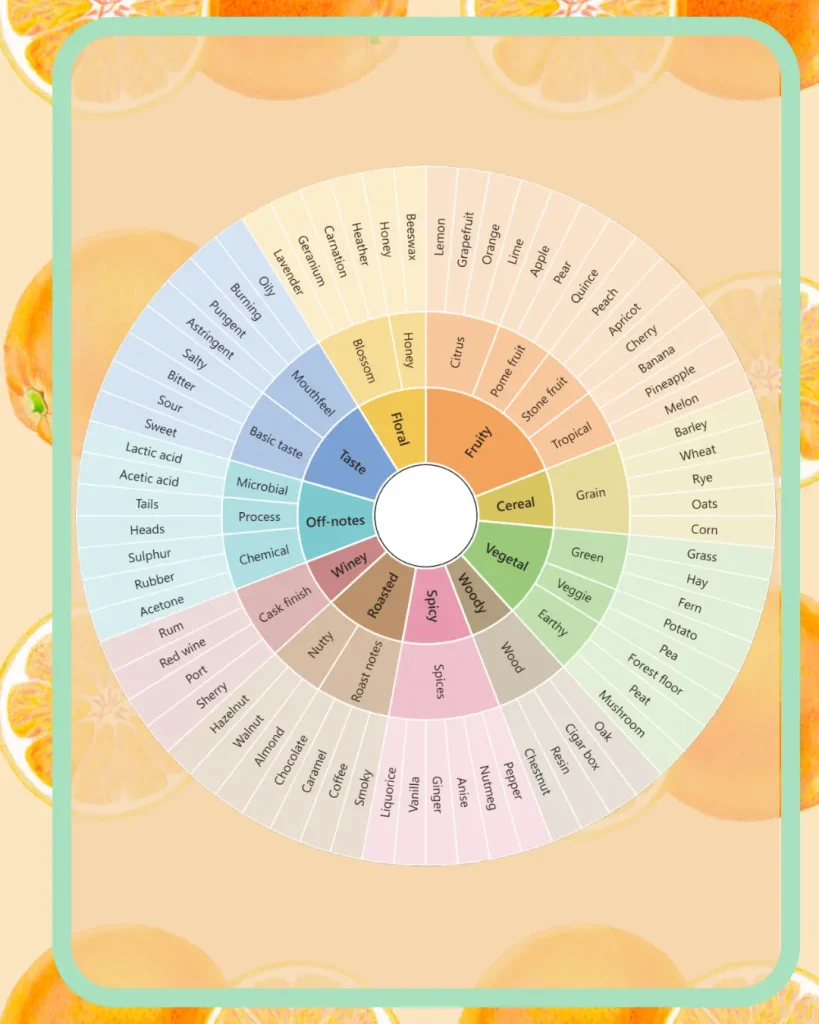
You also have a chance to smell it again later retronasal, when you have the liquid in your mouth and the aromas rise through the throat cavity to the olfactory nerves.
Gustatory Analysis
Finally, the first small sip, let the liquid slowly travel from front to back and return. Take another sip and let the liquid rest a little longer in your mouth.
Now is the time to smell it again retronasally. Because of the warmth and the dilution with saliva in your mouth, you perceive the scent again but differently.
Sweetness: dry – off dry – sweet – lush
Acidity/bitterness: level and balance
Saltiness/umami: presence and impact on profile
Alcohol warmth: mild – smooth – warming – harsh
Body: light – medium – full
Intensity: neutral – delicate – moderate – strong
Midpalate: mouthfeel (watery vs. oily), body (light vs. full)
Balance: sweet vs. acidic vs. bitter; alcohol warmth
Finish & Conclusion
Now for the finish, what remains of the spirit?
Clean: well-defined flavors
Off-notes in finish: grittiness, excessive bitterness, harsh burn.
Evolving: new notes emerge post swallow
Persistence: lingering flavor compounds
Mouthfeel: dryness, astringency, oiliness
Duration: short (-5 s) – medium (5–10 s) – long (+10 s)
Write all down for your own conclusion, go through all your results and create a final picture for yourself.
Final Thoughts
Taking part in a tasting does not simply mean drinking. There are many things to keep in mind and consider. That doesn’t mean, however, that it can’t be fun.
The more practice you have, the more fun it becomes—especially when you start to understand the connections between how a spirit is made and its taste and aroma.